Home

Advancing mHealth by connecting global health professionals to people, products, and ideas.

  • Home
  • Contact
  • Global Digital Health Network

Search form

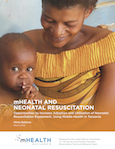
mHealth and Neonatal Resuscitation: Opportunities to Increase Adoption and Utilization of Neonatal Resuscitation Equipment, Using Mobile Health in Tanzania

mHealth Alliance Publication. The mHealth Alliance has undertaken a series of research efforts to identify opportunities for mobile technology to support the goals of the United Nations Commission for Life Saving Commodities for Women and Children (UNCoLSC). In February 2014, a literature review and field visit to Tanzania was conducted to understand: the scope of birth asphyxia in Tanzania; the current adoption and utilization of neonatal resuscitation equipment; government priorities and key stakeholders supporting the prevention of deaths from complications related to birth asphyxia; and opportunities for mHealth to improve identified gaps and barriers in the system. This report outlines the findings from the research and aims to serve as a foundation for informing the development of a country strategy. March 2014

Publication Year: 
2014
Resource Type: 
mHealth Alliance
Language: 
English
↑
USAID

Powered by

Powered by K4Health

This website is made possible by the support of the American People through the United States Agency for International Development (USAID). The Knowledge for Health (K4Health) Project is supported by USAID's Office of Population and Reproductive Health, Bureau for Global Health, under Cooperative Agreement #AID-OAA-A-13-00068 with the Johns Hopkins University. K4Health is implemented by the Johns Hopkins Bloomberg School of Public Health's Center for Communication Programs (JHU∙CCP) in collaboration with FHI 360, Management Sciences for Health, and IntraHealth International. The contents of this website are the sole responsibility of JHU∙CCP. The information provided on this website is not official U.S. Government information and does not necessarily represent the views or positions of USAID, the United States Government, or the Johns Hopkins University. Read our full Security, Privacy, and Copyright Policies.

Subscribe to Syndicate
© 2019